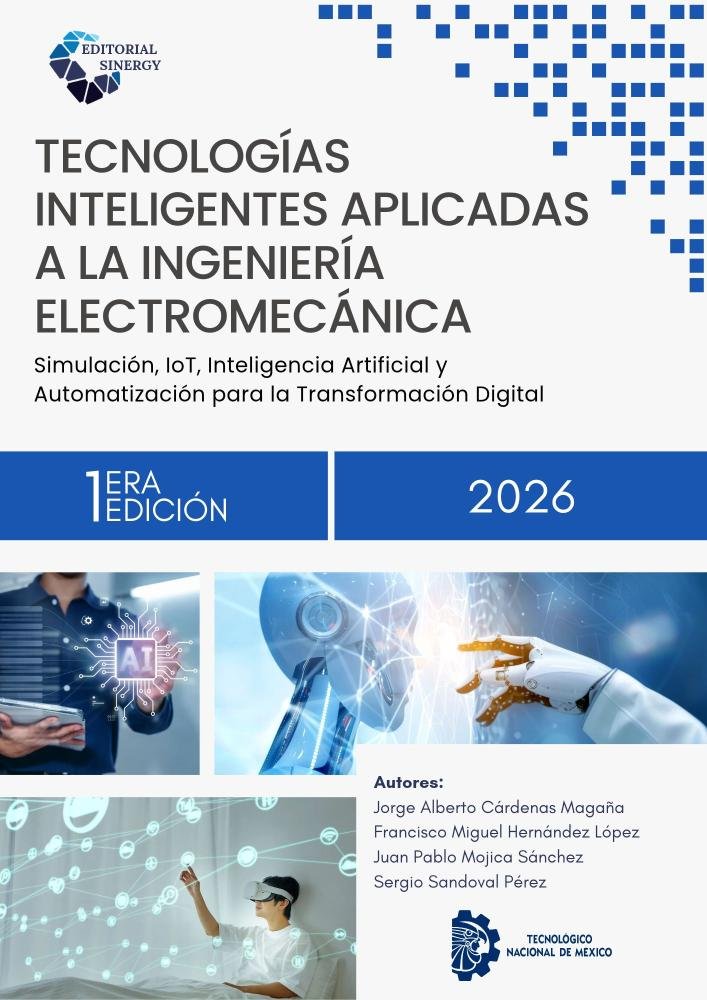
Tecnologías inteligentes aplicadas a la ingeniería electromecánica: simulación, lot, inteligencia artificial y automatización para la transformación digital
Sinopsis
La transformación digital está modificando la forma en que se diseñan, analizan, supervisan y optimizan los sistemas electromecánicos. En este escenario, la integración de tecnologías como la simulación computacional, la programación, el Internet de las Cosas (IoT), el monitoreo inteligente, la inteligencia artificial y la automatización genera nuevas posibilidades para desarrollar sistemas más conectados, eficientes y adaptativos.
El libro Tecnologías Inteligentes Aplicadas a la Ingeniería Electromecánica: Simulación, IoT, Inteligencia Artificial y Automatización para la Transformación Digital presenta una visión integral de esta evolución tecnológica. El primer capítulo aborda los fundamentos de la transformación digital; el segundo analiza la simulación como herramienta para el diseño, análisis y optimización; el tercero examina la programación y los sistemas embebidos; el cuarto estudia el Internet de las Cosas aplicado al monitoreo electromecánico; y el quinto aborda la inteligencia artificial, incluyendo aprendizaje automático, aprendizaje profundo, visión artificial y Edge AI. A lo largo de la obra se destaca que el potencial de estas tecnologías surge de su integración, permitiendo transformar los datos generados por sistemas físicos en información útil para apoyar la toma de decisiones. Esta convergencia ofrece oportunidades para mejorar la eficiencia energética, la confiabilidad, el mantenimiento, la automatización y la sostenibilidad de los sistemas electromecánicos. La obra está dirigida a estudiantes, docentes, investigadores y profesionales de la ingeniería electromecánica y áreas afines interesados en comprender y aplicar tecnologías inteligentes en el contexto de la transformación digital industrial.
Descargas
Los datos de descarga aún no están disponibles.
Referencias
Abadi, M., Agarwal, A., Barham, P., Brevdo, E., Chen, Z., Citro, C., Corrado, G. S., Davis, A., Dean, J., Devin, M., et al. (2016). TensorFlow: Large-scale machine learning on heterogeneous systems. TensorFlow. https://www.tensorflow.org/
Alexander, C. K., & Sadiku, M. N. O. (2022). Fundamentals of electric circuits (7th ed.). McGraw-Hill.
Al-Fuqaha, A., Guizani, M., Mohammadi, M., Aledhari, M., & Ayyash, M. (2015). Internet of Things: A Survey on Enabling Technologies, Protocols, and Applications. IEEE Communications Surveys & Tutorials, 17(4), 2347–2376. https://doi.org/10.1109/COMST.2015.2444095
Al-Fuqaha, A., Guizani, M., Mohammadi, M., Aledhari, M., & Ayyash, M. (2015). Internet of Things: A survey on enabling technologies, protocols, and applications. IEEE Communications Surveys & Tutorials, 17(4), 2347–2376. https://doi.org/10.1109/COMST.2015.2444095
Arrillaga, J., & Watson, N. (2018). Power system harmonics (3rd ed.). Wiley.
Attia, J. O. (2018). Electronics and Circuit Analysis using MATLAB. (2nd ed.) CRC Press. https://doi.org/10.1201/9781315275727
Atzori, L., Iera, A., & Morabito, G. (2010). The Internet of Things: A survey. Computer Networks, 54(15), 2787–2805. https://doi.org/10.1016/j.comnet.2010.05.010
Atzori, L., Iera, A., & Morabito, G. (2010). The Internet of Things: A survey. Computer Networks, 54(15), 2787–2805. https://doi.org/10.1016/j.comnet.2010.05.010
Banks, J., Carson, J. S., Nelson, B. L., & Nicol, D. M. (2010). Discrete-event system simulation (5th ed.). Pearson.
Banzi, M., & Shiloh, M. (2022). Getting started with Arduino (4th ed.). Maker Media.
Barr, M., & Massa, A. (2021). Programming embedded systems: With C and GNU development tools (3rd ed.). O'Reilly Media.
Bollen, M. H. J., & Hassan, F. (2011). Integration of distributed generation in the power system. Wiley-IEEE Press. https://doi.org/10.1002/9781118029039
Bolton, W. (2015). Mechatronics: Electronic Control Systems in Mechanical and Electrical Engineering. (6th ed.). Pearson Education.
Bolton, W. (2021). Programmable logic controllers (7th ed.).
Bommasani, R., Hudson, D. A., Adeli, E., Altman, R., Arora, S., von Arx, S., Bernstein, M. S., Bohg, J., Bosselut, A., Brunskill, E., Brynjolfsson, E., & Buch, S. (2021). On the opportunities and risks of foundation models. Stanford Center for Research on Foundation Models. https://arxiv.org/abs/2108.07258
Boyer, S. A. (2010). SCADA: Supervisory Control and Data Acquisition (4th ed.). International Society of Automation.
Bradski, G., & Kaehler, A. (2017). Learning OpenCV 3: Computer vision in C++ with the OpenCV library. O'Reilly Media.
Breivold, H. P., & Sandström, K. (2025). Edge AI and distributed intelligence for industrial cyber-physical systems: Challenges and opportunities. Journal of Industrial Information Integration, 42, 100731. https://doi.org/10.1016/C2023-0-51364-3
Breque, M., De Nul, L., & Petridis, A. (2021). Industry 5.0: Towards a sustainable, human-centric and resilient European industry. European Commission. https://op.europa.eu/publication-detail/-/publication/468a892a-5097-11eb-b59f-01aa75ed71a1
Carvalho, T. P., Soares, F. A. A. M. N., Vita, R., Francisco, R. P., Basto, J. P., & Alcalá, S. G. S. (2019). A systematic literature review of machine learning methods applied to predictive maintenance. Computers & Industrial Engineering, 137, 106024. https://doi.org/10.1016/j.cie.2019.106024
Carvalho, T. P., Soares, F. A. A. M. N., Vita, R., Francisco, R. P., Basto, J. P., & Alcalá, S. G. S. (2019). A systematic literature review of machine learning methods applied to predictive maintenance. Computers & Industrial Engineering, 137, 106024. https://doi.org/10.1016/j.cie.2019.106024
Chapman, S. J. (2023). Electric machinery fundamentals (6th ed.). McGraw-Hill.
Chen, B., Wan, J., Shu, L., Li, P., Mukherjee, M., & Yin, B. (2018). Smart factory of Industry 4.0: Key technologies, application case, and challenges. IEEE Access, 6, 6505–6519. https://doi.org/10.1109/ACCESS.2017.2783682
Dorf, R. C., & Bishop, R. H. (2021). Modern control systems (14th ed.). Pearson.
Dorf, R. C., & Svoboda, J. A. (2021). Introduction to electric circuits (10th ed.). Wiley.
European Commission. (2021). Industry 5.0: Towards a sustainable, human-centric and resilient European industry. Publications Office of the European Union. https://data.europa.eu/doi/10.2777/308407
European Commission. (2021). Industry 5.0: Towards a sustainable, human-centric and resilient European industry. Publications Office of the European Union. https://data.europa.eu/doi/10.2777/308407
Fraden, J. (2016). Handbook of modern sensors: Physics, designs, and applications (5th ed.).
Fraile Mora, J. (2008). Máquinas eléctricas (6a ed.). McGraw-Hill.
Frank, A. G., Dalenogare, L. S., & Ayala, N. F. (2019). Industry 4.0 technologies: Implementation patterns in manufacturing companies. International Journal of Production Economics, 210, 15–26. https://doi.org/10.1016/j.ijpe.2019.01.004
Géron, A. (2022). Hands-on machine learning with Scikit-Learn, Keras, and TensorFlow (3rd ed.). O'Reilly Media. http://14.139.161.31/OddSem-0822-1122/Hands-On_Machine_Learning_with_Scikit-Learn-Keras-and-TensorFlow-2nd-Edition-Aurelien-Geron.pdf
Goodfellow, I., Bengio, Y., & Courville, A. (2016). Deep learning. MIT Press. http://www.deeplearningbook.org
Goodfellow, I., Bengio, Y., & Courville, A. (2016). Deep learning. MIT Press. http://www.deeplearningbook.org
Grieves, M. (2019). Virtually Intelligent Product Systems: Digital and Physical Twins. En Complex Systems Engineering (pp.175 -200). American Institute of Aeronautics and Astronautics. https://doi.org/10.2514/5.9781624105654.0175.0200
Grieves, M., & Vickers, J. (2017). Digital twin: Mitigating unpredictable, undesirable emergent behavior in complex systems. En F.-J. Kahlen, S. Flumerfelt & A. Alves (Eds.), Transdisciplinary perspectives on complex systems (pp. 85–113). Springer. https://doi.org/10.1007/978-3-319-38756-7_4
Groover, M. (2020). Fundamentals of modern manufacturing: Materials, processes, and systems (7th ed.). Wiley.
Groover, M. P. (2019). Automation, production systems, and computer-integrated manufacturing (5th ed.). Pearson.
Groover, M. P. (2021). Automation, production systems, and computer-integrated manufacturing (5th ed.).
Gubbi, J., Buyya, R., Marusic, S., & Palaniswami, M. (2013). Internet of Things (IoT): A vision, architectural elements, and future directions. Future Generation Computer Systems, 29(7), 1645–1660. https://doi.org/10.1016/j.future.2013.01.010
Hayt, W. H., Kemmerly, J. E., & Durbin, S. M. (2019). Engineering circuit analysis (9th ed.). McGraw-Hill.
Hermann, M., Pentek, T. and Otto, B. (2016) Design Principles for Industrie 4.0 Scenarios. Proceedings of 49th Hawaii International Conference on System Sciences HICSS, Koloa, 5-8 January 2016, 3928-3937. https://doi.org/10.1109/HICSS.2016.488
Hu, S., Li, C., Li, B., Yang, M., Wang, X., Gao, T. Xu, W., Dambatta, Y. S., Zhou, S. & Xu, P. (2024). Digital Twins Enabling Intelligent Manufacturing. Intelligent Manufacturing. Intelligent and Sustainable Manufacturing, 1 (1), 10007. https://doi.org/10.35534/ism.2024.10007
Hu, Y., Jia, Q., Yao, Y., Lee, Y., Lee, M., Wang, C., Zhou, X., Xie, R., & Yu, F. (2024). Industrial Internet of Things Intelligence Empowering Smart Manufacturing: A Literature Review. IEEE Internet of Things Journal. https://doi.org/10.1109/JIOT.2024.3367692
Illuminating Engineering Society (IES). (2020). Lighting Handbook (11th ed.).
International Electrotechnical Commission (2014) Rotating electrical machines - Part 30-1: Efficiency classes of line operated AC motors (IE code). (IEC 60034-30-1:2014).
International Energy Agency. (2023). Energy efficiency 2023. IEA. https://www.iea.org/reports/energy-efficiency-2023
International Energy Agency. (2024). World energy outlook 2024. https://www.iea.org/reports/world-energy-outlook-2025
International Organization for Standardization. (2018). Energy management systems—Requirements with guidance for use (ISO 50001:2018). ISO. https://www.iso.org/obp/ui#iso:std:iso:50001:ed-2:v1:es
James, G., Witten, D., Hastie, T., & Tibshirani, R. (2021). An introduction to statistical learning: With applications in R (2nd ed.). Springer. https://doi.org/10.1007/978-1-0716-1418-1
Jamwal, A., Agrawal, R., Sharma, M., Kumar, V., Kumar, S., & Gupta, R. (2022). Industry 4.0 technologies for manufacturing sustainability: A systematic review and future research directions. Applied Sciences, 12(11), 5725. https://doi.org/10.3390/app11125725
Jardine, A. K. S., Lin, D., & Banjevic, D. (2006). A review on machinery diagnostics and prognostics implementing condition-based maintenance. Mechanical Systems and Signal Processing, 20(7), 1483–1510. https://doi.org/10.1016/j.ymssp.2005.09.012
Javaid, M., Haleem, A., Singh, R. P., Khan, S., & Suman, R. (2022). Understanding the adoption of Industry 4.0 technologies in improving environmental sustainability. Sustainable Operations and Computers, 3, 203–217. https://doi.org/10.1016/j.susoc.2022.01.008
Javaid, M., Haleem, A., Singh, R. P., Suman, R., & Gonzalez, E. S. (2022). Understanding the adoption of Industry 4.0 technologies in improving environmental sustainability. Sustainable Operations and Computers, 3, 203–217. https://doi.org/10.1016/j.susoc.2022.01.008
Jocher, G., Chaurasia, A., & Qiu, J. (2024). Ultralytics YOLO Documentation. Ultralytics. https://docs.ultralytics.com/
Kagermann, H., Wahlster, W., & Helbig, J. (2013). Recommendations for implementing the strategic initiative Industrie 4.0. Final report of the Industrie 4.0 Working Group. Acatech— National Academy of Science and Engineering, 678. recommendations-for-implementing-industry-4-0-data.pdf
Kagermann, H., Wahlster, W., & Helbig, J. (2013). Securing the Future of German Manufacturing Industry: Recommendations for Implementing the Strategic Initiative INDUSTRIE 4.0. Final Report of the Industrie 4.0 Working Group. Forschungsunion im Stifterverband für die Deutsche Wirtschaft e.V. https://en.acatech.de/publication/recommendations-for-implementing-the-strategic-initiative-industrie-4-0-final-report-of-the-industrie-4-0-working-group/
Karkaria, V., Tsai, Y., Chen, Y., & Chen, W. (2025). An optimization-centric review on integrating artificial intelligence and digital twin technologies in manufacturing. Engineering Optimization, 57(1), 161–207. https://doi.org/10.1080/0305215X.2024.2434201
Karniadakis, G. E., Kevrekidis, I. G., Lu, L., Perdikaris, P., Wang, S., & Yang, L. (2021). Physics-informed machine learning. Nature Reviews Physics, 3(6), 422–440. https://doi.org/10.1038/s42254-021-00314-5
Kolban, N. (2021). Kolban’s book on ESP32. Leanpub.
Krause, P. C., Wasynczuk, O., Sudhoff, S. D., & Pekarek, S. (2013). Analysis of electric machinery and drive systems (3rd ed.). Wiley-IEEE Press.
Kusiak, A. (2018). Smart manufacturing. International Journal of Production Research, 56(1–2), 508–517. https://doi.org/10.1080/00207543.2017.1351644
Kusiak, A. (2024). Smart manufacturing powered by artificial intelligence. Journal of Manufacturing Systems, 73, 320–330. https://doi.org/10.1016/j.jmsy.2024.02.005
Lasi, H., Fettke, P., Kemper, H., Feld, T., & Hoffmann, M. (2014). Industry 4.0. Business & Information Systems Engineering, 6(4), 239–242. https://doi.org/10.1007/s12599-014-0334-4
Lasi, H., Fettke, P., Kemper, H., Feld, T., & Hoffmann, M. (2014). Industry 4.0. Business & Information Systems Engineering, 6(4), 239–242. https://doi.org/10.1007/s12599-014-0334-4
Lasi, H., Fettke, P., Kemper, H., Feld, T., & Hoffmann, M. (2014). Industry 4.0. Business & Information Systems Engineering, 6(4), 239–242. https://doi.org/10.1007/s12599-014-0334-4
Lasi, H., Fettke, P., Kemper, H.-G., Feld, T., & Hoffmann, M. (2014). Industry 4.0. Business & Information Systems Engineering, 6(4), 239–242. https://doi.org/10.1007/s12599-014-0334-4
Law, A. M. (2015). Simulation modeling and analysis (5th ed.). McGraw-Hill.
LeCun, Y., Bengio, Y., & Hinton, G. (2015). Deep learning. Nature, 521(7553), 436–444. https://doi.org/10.1038/nature14539
Lee, E. A., & Seshia, S. A. (2016). Introduction to embedded systems: A cyber-physical systems approach (2nd ed.). MIT Press.
Lee, I. & Lee, K. (2015) The Internet of Things (IoT): Applications, investments, and challenges for enterprises. Business Horizons, 58 (4), 431-440.
https://doi.org/10.1016/j.bushor.2015.03.008
Lee, J., Bagheri, B., & Kao, H. A. (2015). A cyber-physical systems architecture for Industry 4.0-based manufacturing systems. Manufacturing Letters, 3, 18–23. https://doi.org/10.1016/j.mfglet.2014.12.001
Lee, J., Bagheri, B., & Kao, H.-A. (2015). A cyber-physical systems architecture for Industry 4.0-based manufacturing systems. Manufacturing Letters, 3, 18–23. https://doi.org/10.1016/j.mfglet.2014.12.001
Lee, J., Bagheri, B., & Kao, H.-A. (2015). A cyber-physical systems architecture for Industry 4.0-based manufacturing systems. Manufacturing Letters, 3, 18–23. https://doi.org/10.1016/j.mfglet.2014.12.001
Leng, J., Ruan, G., Jiang, P., Xu, K., Liu, Q., Zhou, X., & Liu, C. (2023). Blockchain-empowered sustainable manufacturing and product lifecycle management in industry 4.0: A survey. Renewable and Sustainable Energy Reviews,132, 110112. https://doi.org/10.1016/j.rser.2020.110112
Meindl, B., & Mendonça, J. (2021). Mapping Industry 4.0 technologies: From cyber-physical systems to artificial intelligence. arXiv. https://arxiv.org/abs/2111.14168
Mobley, R. K. (2002). An introduction to predictive maintenance (2nd ed.). Butterworth-Heinemann. https://doi.org/10.1016/B978-075067531-4/50006-3
Mobley, R. K. (2020). An introduction to predictive maintenance (3rd ed.). Butterworth-Heinemann. https://doi.org/10.1016/B978-075067531-4/50006-3
Monk, S. (2023). Programming the Pico: Learn coding and electronics with the Raspberry Pi Pico (2.ª ed.). MonkMakes Press.
Monostori, L., Kádár, B., Bauernhansl, T., Kondoh, S., Kumara, S., Reinhart, G., Sauer, O., Schuh, G., Sihn, W., & Ueda, K. (2016). Cyber-physical systems in manufacturing. CIRP Annals, 65(2), 621–641. https://doi.org/10.1016/j.cirp.2016.06.005
Mourtzis, D., Angelopoulos, J., Panopoulos, N., & Boli, N. (2024). Integration of extended reality and CAE in the context of industry 4.0. International Journal of Computer Integrated Manufacturing, 38(7), 929–951. https://doi.org/10.1080/0951192X.2024.2397820
must embrace big data. Nature, 544(7648), 23–25. https://doi.org/10.1038/544023a
Mystakidis, S. (2022). Metaverse. Encyclopedia, 2(1), 486–497. https://doi.org/10.3390/encyclopedia2010031
Nilsson, J. W., & Riedel, S. A. (2023). Electric circuits (12th ed.). Pearson.
NVIDIA. (2024). Jetson Orin Nano Developer Kit User Guide. NVIDIA Corporation. https://docs.nvidia.com/jetson/orin-nano-devkit/user-guide/latest/index.html
Ogata, K. (2020). Modern control engineering (6th ed.). Pearson.
Oks, S. J., Jalowski, M., Lechner, M., Mirschberger, S., Merklein, M., Vogel‐Heuser, B. & Möslein, K.M. (2022). Cyber-Physical Systems in the Context of Industry 4.0: A Review, Categorization and Outlook. Information Systems Frontiers. 26(5), 1731–1772. 26(5), 1731–1772. https://doi.org/10.1007/s10796-022-10252-x
Oppenheim, A. V., Willsky, A. S., & Nawab, S. H. (2020). Signals and systems (3rd ed.). Pearson.
Paszke, A., Gross, S., Massa, F., Lerer, A., Bradbury, J., Chanan, G., Killeen, T., Lin, Z., Gimelshein, N., Antiga, L., Desmaison, A., Köpf, A., Yang, E., DeVito, Z., Raison, M., Tejani, A., Chilamkurthy, S., Steiner, B., Fang, L., & Chintala, S. (2019). PyTorch: An imperative style, high-performance deep learning library. En H. Wallach et al. (Eds.), Advances in Neural Information Processing Systems (Vol. 32). Curran Associates, Inc. https://doi.org/10.48550/arXiv.1912.01703
Qi, Q., & Tao, F. (2018). Digital twin and big data towards smart manufacturing and Industry 4.0: 360 degree comparison. IEEE Access, 9, 3585–3593. https://ieeexplore.ieee.org/document/8258937
Raspberry Pi Foundation. (2024). Raspberry Pi Documentation. Raspberry Pi Ltd. https://www.raspberrypi.com/documentation/
Raspberry Pi Foundation. (2024). Raspberry Pi Documentation. Raspberry Pi Ltd. https://www.raspberrypi.com/documentation/
Redmon, J., Divvala, S., Girshick, R., & Farhadi, A. (2016). You only look once: Unified, real-time object detection. En Proceedings of the IEEE Conference on Computer Vision and Pattern Recognition (pp. 779–788). https://doi.org/10.1109/CVPR.2016.91
Russell, S., & Norvig, P. (2021). Artificial intelligence: A modern approach (4th ed.). Pearson.http://lib.ysu.am/disciplines_bk/efdd4d1d4c2087fe1cbe03d9ced67f34.pdf
Ryalat, M., ElMoaqet, H., & AlFaouri, M. (2023). Design of a Smart Factory Based on Cyber-Physical Systems and Internet of Things towards Industry 4.0. Applied Sciences, 13(4), 2156. https://doi.org/10.3390/app13042156
Sánchez, J. M. G., Jörgensen, N., Törngren, M., Inam, R., Berezovskyi, A., Feng, L., Fersman, E., Ramli, M. R., & Tan, K. (2021). Edge computing for cyber-physical systems: A systematic mapping study emphasizing trustworthiness. arXiv. https://arxiv.org/abs/2112.00619
Scheffer, C., & Girdhar, P. (2004). Practical machinery vibration analysis and predictive maintenance.
Schwab, K. (2016). The fourth industrial revolution. Wordl Economic Forum https://www.weforum.org/stories/technological-innovation/the-fourth-industrial-revolution-what-it-means-and-how-to-respond/
Schwab, K. (2016). The fourth industrial revolution. Wordl Economic Forum https://www.weforum.org/stories/technological-innovation/the-fourth-industrial-revolution-what-it-means-and-how-to-respond/
Schwab, K. (2016). The fourth industrial revolution. Wordl Economic Forum https://www.weforum.org/stories/technological-innovation/the-fourth-industrial-revolution-what-it-means-and-how-to-respond/
Schwab, K. (2017). The fourth industrial revolution. Wordl Economic Forum https://law.unimelb.edu.au/__data/assets/pdf_file/0005/3385454/Schwab-The_Fourth_Industrial_Revolution_Klaus_S.pdf
Shi, L., Hailang, D., Reguera, G., Beyenal, H., Lu, A., Liu, J., Yu, H. & Fredrickson, J. (2016) Extracellular Electron Transfer Mechanisms between Microorganisms and Minerals. Nature Reviews Microbiology, 14 (10), 651-662. https://doi.org/10.1038/nrmicro.2016.93
Shi, W., Cao, J., Zhang, Q., Li, Y., & Xu, L. (2016). Edge computing: Vision and challenges. IEEE Internet of Things Journal, 3(5), 637–646. https://doi.org/10.1109/JIOT.2016.2579198
Shi, W., Cao, J., Zhang, Q., Li, Y., & Xu, L. (2016). Edge computing: Vision and challenges. IEEE Internet of Things Journal, 3(5), 637–646. https://doi.org/10.1109/JIOT.2016.2579198
Siano, P. (2014). Demand response and smart grids—A survey. Renewable and Sustainable Energy Reviews, 30, 461–478. https://doi.org/10.1016/j.rser.2013.10.022
Singgih, M., Zakiyyah, F. & Andrew (2024). "Machine Learning for Predictive Maintenance: A Literature Review," 2024 Seventh International Conference on Vocational Education and Electrical Engineering (ICVEE), Malang, Indonesia, 2024, pp. 250-256, https://doi.org/10.1109/ICVEE63912.2024.10823713
Szeliski, R. (2022). Computer vision: Algorithms and applications (2nd ed.). Springer. https://doi.org/10.1007/978-3-030-34372-9
Tan, M., Pang, R., & Le, Q. V. (2020). EfficientDet: Scalable and efficient object detection. En Proceedings of the IEEE/CVF Conference on Computer Vision and Pattern Recognition (pp. 10781–10790). https://doi.org/10.1109/CVPR42600.2020.01079
Tao, F., Xiao, B., Qi, Q., Cheng, J., & Ji, P. (2022). Digital twin modeling. Journal of Manufacturing Systems, 64, 372–389. https://doi.org/10.1016/j.jmsy.2022.06.015
Tao, F., Xiao, B., Qi, Q., Cheng, J., & Ji, P. (2022). Digital twins and cyber-physical systems toward smart manufacturing and Industry 5.0. Engineering, 9, 56–74. https://doi.org/10.1016/j.eng.2019.01.014
Tao, F., Xiao, B., Qi, Q., Cheng, J., & Jib, P. (2022). Digital twin modeling. Journal of Manufacturing Systems, 64, 372–389. https://doi.org/10.1016/j.jmsy.2022.06.015
Tao, F., Zhang, H., Liu, A., & Nee, A. Y. C. (2019). Digital Twin in Industry: State-of-the-Art. IEEE Transactions on Industrial Informatics, 15(4), 2405–2415.
https://doi.org/10.1109/tii.2018.2873186
Tao, F., Zhang, H., Liu, A., & Nee, A. Y. C. (2019). Digital twin in industry: State-of-the-art. IEEE Transactions on Industrial Informatics, 15(4), 2405–2415. https://doi.org/10.1109/TII.2018.2873186
Tao, F., Zhang, H., Liu, A., & Nee, A. Y. C. (2019). Digital Twin in Industry: State-of-the-Art. IEEE Transactions on Industrial Informatics, 15(4), 2405–2415.
https://doi.org/10.1109/tii.2018.2873186
Thramboulidis, K., Vachtsevanou, D. C., & Kontou, I. (2018). CPuS-IoT: A cyber-physical microservice and IoT-based framework for manufacturing assembly systems. arXiv. https://arxiv.org/abs/1807.07363
Thramboulidis, K., Vachtsevanou, D. C., & Solanos, A. (2018). Cyber-physical microservices: An IoT-based framework for manufacturing systems. arXiv. https://arxiv.org/abs/1801.10340
Thumann, A., & Younger, W. J. (2023). Handbook of Energy Audits (10th ed.). CRC Press.
Tsallis, C., Papageorgas, P., Piromalis, D., & Munteanu,. (2025). Application-Wise Review of Machine Learning-Based Predictive Maintenance: Trends, Challenges, and Future Directions. Applied Sciences, 15(9), 4898. https://doi.org/10.3390/app15094898
Xu, J., Liu, X., & Jiang, X (2023). The Practical Approach of News Production and Human-Machine Coupling with Generative Artificial Intelligence. Journal of Nanchang University (Humanities and Social Sciences), 54 (05), 114-122.
Xu, L. D., He, W., & Li, S. (2014). Internet of things in industries: A survey. IEEE Transactions on Industrial Informatics, 10(4), 2233–2243. https://doi.org/10.1109/TII.2014.2300753
Xu, X., Lu, Y., Vogel-Heuser, B., & Wang, L. (2021). Industry 4.0 and Industry 5.0—Inception, conception and perception. Journal of Manufacturing Systems, 67, 530–535. https://doi.org/10.1016/j.jmsy.2021.10.006
Zhang, W., Yang, D., & Wang, H. (2019). Data-driven methods for predictive maintenance of industrial equipment: A survey. IEEE Systems Journal, 13(3), 2213–2227. https://doi.org/10.1109/JSYST.2019.2905565
Zhou, J., Zhang, B., Li, G., Chen, X., Li, H., Xu, X., Chen, S., He, W., Xu, C., Liu, L., & Gao, X. (2024). An AI agent for fully automated multi-omic analyses. Advanced Science, 11(44), 2407094. https://advanced.onlinelibrary.wiley.com/doi/10.1002/advs.202407094
Zhou, K., Liu, T., & Zhou, L. (2024). Industry 4.0: Towards future industrial opportunities and challenges. Computers in Industry, 163, 104045. https://doi.org/10.1109/FSKD.2015.7382284
Descargas
Publicado
agosto 25, 2026
Colección
Derechos de autor 2026 Editorial Sinergy
Licencia

Esta obra está bajo una licencia internacional Creative Commons Atribución-NoComercial-CompartirIgual 4.0.
Detalles sobre esta monografía
ISBN-13 (15)
978-612-99320-6-4
Cómo citar
Cárdenas Magaña, J. A. ., Hernández López, F. M. ., Mojica Sánchez, J. P. ., & Sandoval Pérez, S. . (2026). Tecnologías inteligentes aplicadas a la ingeniería electromecánica: simulación, lot, inteligencia artificial y automatización para la transformación digital. Editorial Sinergy. https://doi.org/10.5281/zenodo.23348794