Chapter 9 - The available and appropriate methods in legal education at the higher education level
Synopsis
Higher education is facing a transitional stage in its training models, where methodological processes are becoming increasingly important. In legal education, many students fail to achieve metacognition of content due to methodologies that hinder the contextualization and application of theoretical knowledge. Therefore, it is essential to promote an active student role, the development of professional competencies, meaningful learning, collaboration, and autonomy. This documentary research, conducted at the Faculty of Law of the “Benito Juárez” Autonomous University of Oaxaca, identified pedagogical and didactic theories and models applied in legal studies. Based on their characteristics, it proposes structuring the teaching-learning process through active methodologies aimed at strengthening competencies, fostering autonomy, and organizing activities according to Bloom’s taxonomy, with the goal of achieving metacognition. Objective: To identify and characterize pedagogical-didactic theories and models that structure the teaching-learning process in Law at UABJO, facilitating metacognition through active methodologies. Methodology: Documentary research with a qualitative approach, analyzing theories and models that support active methodologies aligned with the educational objectives of the Law degree, promoting professional competencies and autonomy. Results: The constructivist pedagogical model and active methodologies, linked to Bloom’s taxonomy, favor legal education. Situated learning and communities of practice strengthen metacognition and meaningful learning in Law. Conclusion: This work provides a clear vision of the most effective teaching methods for the legal field, and proposes pedagogical improvements based on the active methodologies identified as most suitable for consolidating learning.
Downloads
Pages
230-253
Published
June 30, 2025
Series
Copyright (c) 2025 Sinergy Editorial
License

This work is licensed under a Creative Commons Attribution-NonCommercial-ShareAlike 4.0 International License.
How to Cite
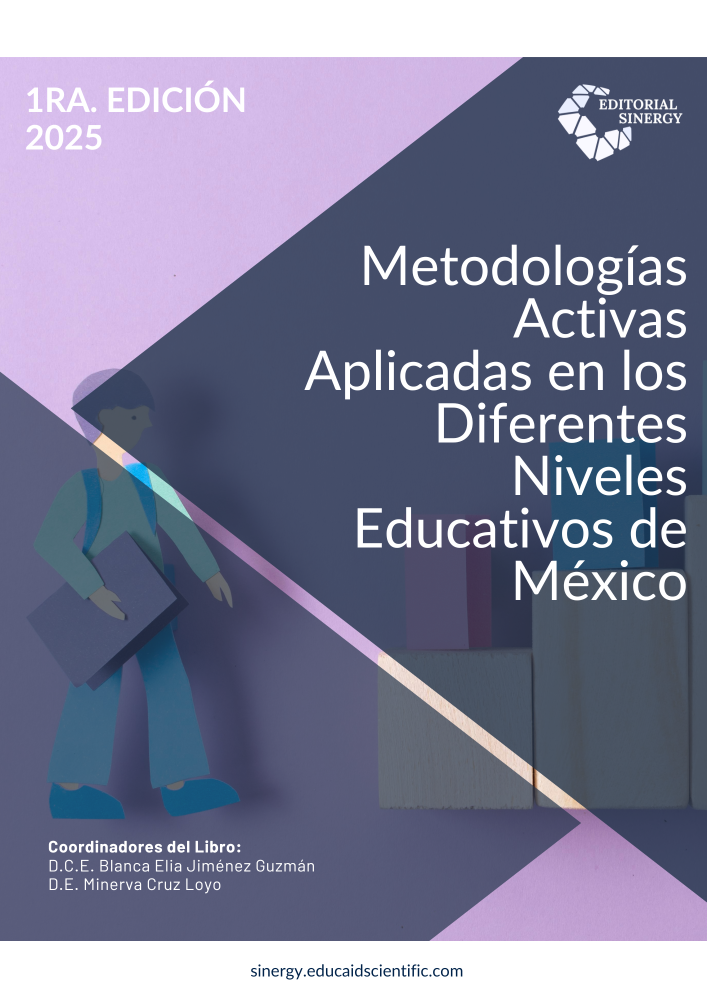
Montero-Hernández, L., Vicente-Pinacho, A. J., Castillejos-Moguel, F., & Luis-Zarate, M. (2025). Chapter 9 - The available and appropriate methods in legal education at the higher education level . In B. E. Jiménez-Guzmán & M. Cruz-Loyo (Eds.), & (Ed.), Active methodologies applied at different educational levels in Mexico (pp. 230-253). Sinergy Editorial. https://doi.org/10.5281/zenodo.17635127