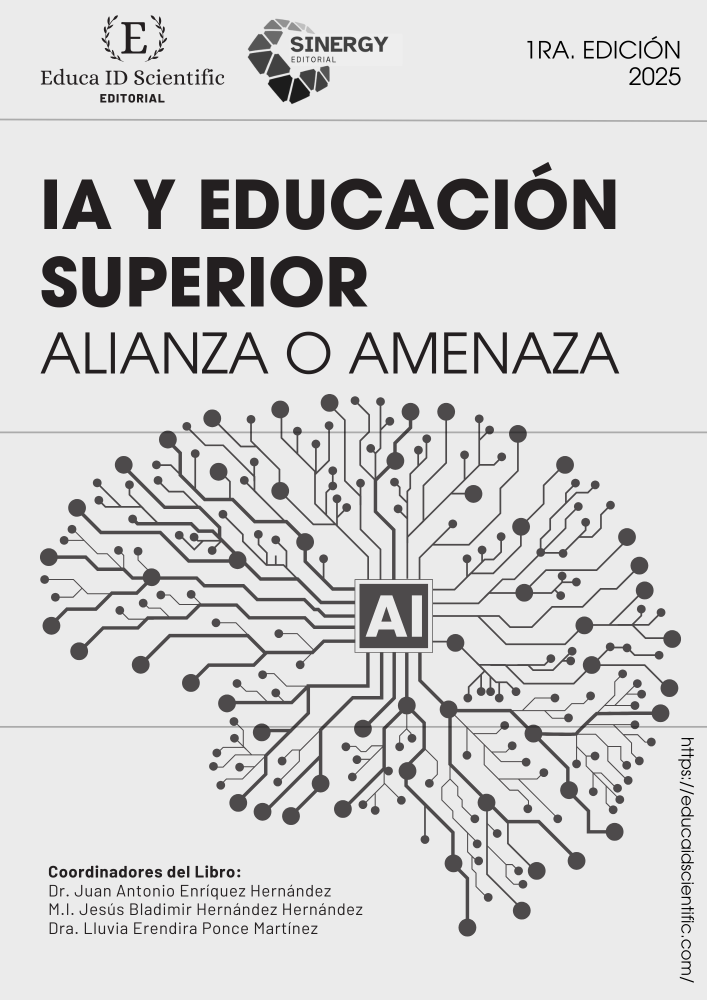
AI and Higher Education: Alliance or Threat
Synopsis
The penetration of artificial intelligence in the field of education is no longer a futuristic concept but has become something real, tangible, and transformative. In some higher education programs, its integration poses a profound and troubling, yet fascinating dilemma: Is AI a strategic ally for pedagogical innovation, research, and meaningful learning, or does it, on the contrary, represent a threat to the development of fundamental skills, equity, and the very essence of the educational process? This book does not seek to offer a unilateral answer, but rather a multifaceted and critical analysis through the lens of four specific research projects that exemplify the achievements and tensions of this new digital era.
The works that make up this section emerge from different fields of knowledge, demonstrating the cross-cutting impact of AI and associated technologies: The first transports us to the fascinating world of chemistry, now digitally enhanced. There, molecular simulation, big data, and artificial intelligence algorithms are no longer exclusive research tools but have become educational pillars. This contribution shows how the use of AI is a powerful ally, promoting participatory, active, visual, and contextualized learning in a particular environment, which brings students closer to complex scientific problems in a safe and inspiring way.
However, the scenario becomes more complex when the field changes. The second study takes us into the realm of human talent administration and management within business institutions. AI promises to focus and optimize recruitment, training, and professional development processes, which can represent an alliance for organizational efficiency. However, the research also reveals the underlying challenges: the need for constant updating of skills in order to avoid the risk of obsolescence and the urgency of creating an organizational culture capable of assimilating technological change in an ethical and equitable manner. Here, the disruption/threat manifests itself in the management of people who, in turn, are responsible for training new generations.
The tension reaches its most critical point in the third article, which examines programming learning. AI stands here as a double-edged tool. On the one hand, it is a tireless tutor that offers immediate feedback and personalization, accelerating the learning curve. On the other, its premature or indiscriminate use can create a dangerous dependency, supplanting the construction of computational logic and essential algorithmic thinking. This work emphasizes the risk that the disruptive tool will end up eroding the very foundations of the discipline it aims to teach, becoming a threat to the student's cognitive autonomy if not mediated by a solid educational strategy.
Finally, the fourth study, although focused on food science, provides invaluable methodological insight. By using rigorous experimental design and data analysis to evaluate a product's shelf life, it reminds us that the core of higher education remains the scientific method, critical thinking, and empirical validation. In a world driven by data and algorithms, this work serves as a counterpoint and reminder: the most advanced technology must be at the service of systematic inquiry and real-world problem solving, not an end in itself.
Together, these four articles weave a coherent discourse on the complex crossroads facing higher education. Artificial intelligence is an ecosystem of tools whose value, “whether as an ally or a threat,” is defined by the context of its application, pedagogical intent, teacher training, and the ethical frameworks that guide it. This introduction and the chapters that follow invite the reader to delve into a thoughtful and situated analysis, where the real challenge is not to adopt or reject AI, but to learn to use it wisely, critically, and responsibly so that it can effectively consolidate itself as the great ally of human intellect that it promises to be.
Chapters
-
Teaching Chemistry in the Digital Age: Molecular Simulation, Big Data, and Artificial Intelligence
-
Change management in the AI era: challenges and opportunities for human talent administration
-
Artificial Intelligence as a Disruptive Tool in Programming Learning
-
Shelf life and sensory quality study of probiotic jalapeño pepper sauces (Capsicum annuum), in Las Choapas
Downloads
Download data is not yet available.
References
Adamo, C., & Barone, V. (1999). Toward reliable density functional methods without adjustable parameters: The PBE0 model. The Journal of Chemical Physics, 110(13), 6158–6170. https://doi.org/10.1063/1.478522
Ali, S. B., Talib, C. A., & Jamal, A. M. (2023). Digital technology approach in chemistry education: A systematic literature review. Journal of Natural Science and Integration, 6(1), 1-13.
Almasri, F. (2024). Exploring the impact of artificial intelligence in teaching and learning of science: A systematic review of empirical research. Research in Science Education, 54(5), 977-997.
Arenas, R. D. M., Cerna, A. N. F., Ramos, M. R. M., Serón, G. I. E., Loli, M. B. L. C., & Leon, G. H. C. (2023). La educación virtual como ciencia: Tendencias en herramientas informáticas.
Bitencourt-Ferreira, G., & de Azevedo, W. F. Jr. (2019). Molegro Virtual Docker for docking. En W. F. de Azevedo Jr. (Ed.), Methods in Molecular Biology (Vol. 2053, pp. 149–167). Springer.
Chiu, W. K. (2021). Pedagogy of emerging technologies in chemical education during the era of digitalization and artificial intelligence: A systematic review. Education sciences, 11(11), 709.
Chavez Gómez, Y. A., & Cuaran Ceballos, A. D. (2024). Implementación del simulador PhET para la enseñanza de balanceo de ecuaciones químicas en estudiantes de grado décimo comparado con el modelo tradicional en la IEM La Rosa de Pasto (Doctoral dissertation, San Juan de Pasto-Nariño [Colombia]: Universidad CESMAG).
ChemCraft. (2016). ChemCraft 1.6 [Computer software]. https://www.chemcraftprog.com
Cheng, Y.-P., Pedaste, M., Bardone, E., & Huang, Y.-M. (Eds.). (2024). Innovative technologies and learning: 7th International Conference, ICITL 2024, Tartu, Estonia, August 14–16, 2024, proceedings, part I (Lecture Notes in Computer Science, Vol. 14785). Springer Nature Switzerland AG.
Gómez-Zermeño, M. G. (2023). Inteligencia Artificial: Conceptos clave y experiencias en prácticas educativas. Portal de Investigación.
Gómez, B. R. (2005). Aprendizaje basado en problemas (ABP): Una innovación didáctica para la enseñanza universitaria. Educación y educadores, (8), 9-20.
Grimme, S., Antony, J., Ehrlich, S., & Krieg, H. (2010). A consistent and accurate ab initio parametrization of density functional dispersion correction (DFT-D) for the 94 elements H–Pu. The Journal of Chemical Physics, 132(15), 154104.
Kılınç, S. (2023). Embracing the future of distance science education: Opportunities and challenges of ChatGPT integration. Asian Journal of Distance Education, 18(1), 205–237. https://doi.org/10.5281/zenodo.7857396.
Likert, R. (1932). A technique for the measurement of attitudes. Archives of Psychology, 22(140), 1–55.
Mazzuco, A., Krassmann, A. L., Reategui, E., & Gomes, R. S. (2022). A systematic review of augmented reality in chemistry education. Review of Education, 10(1), e3325.
Neese, F. (2022). Software update: The ORCA program system, version 5.0. Wiley Interdisciplinary Reviews: Computational Molecular Science, 12(1), e1606.
Tello, A. E. C., Ramírez, H. C. G., Sosa, P. C. H., Sánchez, M. Á. F., & Paucar, E. C. (2023). El uso del Aprendizaje Basado en Problemas (ABP) en la educación superior. Educa UMCH, (21), 29-44.
Pazos-Yerovi, E. I., & Aguilar-Gordón, F. D. R. (2024). El Aprendizaje Basado en Problemas como estrategia metodológica para el desarrollo del Pensamiento Crítico. Revista de estudios y experiencias en educación, 23(53), 313-340.
Perkins, K. K., Adams, W. K., Dubson, M., Finkelstein, N. D., Reid, S., Wieman, C. E., & LeMaster, R. (2006). PhET: Interactive simulations for teaching and learning physics. University of Colorado Boulder.
Wang, S., Wang, F., Zhu, Z., Wang, J., Tran, T., & Du, Z. (2024). Artificial intelligence in education: A systematic literature review. Expert Systems with Applications, 252, 124167.
Wavefunction, Inc. (2008). Spartan’08 [Computer software]. Wavefunction, Inc.
Weigend, F., & Ahlrichs, R. (2005). Balanced basis sets of split valence, triple zeta valence and quadruple zeta valence quality for H to Rn: Design and assessment of accuracy. Physical Chemistry Chemical Physics, 7(18), 3297–3305.
Cadillo, R. I. T. (2023). Los riesgos y los desafíos que enfrentan los trabajadores frente al uso de la inteligencia artificial en el trabajo. Revista de Derecho Procesal del Trabajo, *6*(7), 289-313. https://doi.org/10.47308/rdpt.v6i7.778
Cárdenas, C. V. G., Pacheco, E. S. A., Macías, R. A. S., & Vásquez, G. P. V. (2024). Inteligencia artificial en la formación y desarrollo del talento humano en las organizaciones públicas y privadas. Suplemento Cica Multidisciplinario, *8*(017), 1-19. https://doi.org/10.56124/scicam.v8i017.101
Contreras, F. C. (2025). Revolucionando el desarrollo organizacional: La influencia de la inteligencia artificial en la transformación empresarial. Ciencia Latina Revista Científica Multidisciplinaria, *9*(1), 1-10. https://doi.org/10.37811/cl_rcm.v9i1.16466
Fernández, A. M., & de Lama, S. D. P. (2018). La cuarta revolución industrial y la agenda digital de las organizaciones. Economía Industrial, *407*, 95-104.
Fenwick, A. (2024). Revisiting the role of HR in the age of AI: Bringing humans and machines closer together in the workplace. Frontiers in Artificial Intelligence, *7*, 1272823. https://doi.org/10.3389/frai.2023.1272823
Foffano, F., Scantamburlo, T., & Cortés, A. (2022). Invertir en IA para el bien social: Un análisis de las estrategias nacionales europeas. AI & Sociedad, *38*, 479-500. https://doi.org/10.1007/s00146-022-01445-8
Gil, C. A. R. (2024). Talento humano e inteligencia artificial en el desempeño laboral en un gobierno regional de Perú. Revista de Climatología, Edición Especial Ciencias Sociales, *24*, 1323-1348. https://doi.org/10.59427/rcli/2024/v24cs.1322-1348
Gong, Q., Fan, D., & Bartram, T. (2024). Integrating artificial intelligence and human resource management: A review and future research agenda. The International Journal of Human Resource Management, *35*(12), 2335-2365. https://doi.org/10.1080/09585192.2024.2440065
Herrera, M. B. G., Reyes, E. J. R., & Acosta, F. A. S. (2023). Estudio cualitativo sobre la interacción de la inteligencia artificial con el desarrollo de las habilidades cruciales del capital humano. Ciencia Latina Revista Multidisciplinaria, *7*(6), 42. https://doi.org/10.37811/cl_rcm.v7i6.8855
Khan, M. R. (2024). Application of artificial intelligence for talent management: Challenges and opportunities. En T. Ahram, R. Taiar, K. Langlois, & A. Choplin (Eds.), Intelligent human systems integration (pp. 324–329). AHFE International. https://doi.org/10.54941/ahfe1004496
López, I. D. (2024). El impacto de los sistemas algorítmicos en los procesos de selección de personal. Análisis jurídico-laboral a la luz del nuevo reglamento europeo en materia de inteligencia artificial. Revista de Trabajo y Seguridad Social. CEF, *478*, 49-82. https://doi.org/10.51302/rtss.2024.22257
Marengo, S. A. G. (2023). ¿Por qué la IA generará una crisis del empleo en América Latina y cómo enfrentarla? Política Internacional, *134*, 75-93. https://doi.org/10.61249/pi.vi134.91
Mir, A. I. (2024). Application of AI in talent management: A systematic review of benefits, challenges, and prospects. Academy of Education and Social Sciences Review, *4*(4), 612-630. https://doi.org/10.48112/aessr.v4i4.941
Oeij, P., Preenen, P., van der Torre, W., van der Meer, L., & van den Eerenbeemt, J. (2019). Elección tecnológica e innovación en el lugar de trabajo: Hacia un trabajo eficiente y humanizado. Revista Europea de Innovación Pública y Social, *4*(1), 15-26. https://doi.org/10.31637/EPSIR.19-1.2
Ore, O., & Sposato, M. (2021). Opportunities and risks of artificial intelligence in recruitment and selection. International Journal of Organizational Analysis, *29*(5), 1349-1365. https://doi.org/10.1108/IJOA-07-2020-2291
Pandolfi, D., & Villagra, A. (2025). Inteligencia artificial y trabajo: Todo es caos bajo las estrellas. RevITA, Revista Electrónica del Instituto de Tecnología Aplicada, Universidad Nacional de la Patagonia Austral, *3*(1), 1-10. https://doi.org/10.37811/cl_rcm.v9i1.16466
Ruiz, F. J. B. (2022). La paradoja de la transparencia en la IA: Opacidad y explicabilidad. Atribución de responsabilidad. Revista Internacional de Pensamiento Político, *17*, 261-272. https://doi.org/10.46661/revintpensampolit.7526
Saxena, A., Dias, R. T., & Irfan, M. (2024). AI's strategic role in HR management. En T. A. Editor (Ed.), Advances in human resource management (pp. 145-162). IGI Global. https://doi.org/10.4018/979-8-3693-6412-3.ch008
Valderrama, B. (2019). Transformación digital y organizaciones ágiles. Arandu UTIC, *6*(1), 15-50.
Vergés, C. (2022). 17*(1), 45-62. https://doi.org/10.18270/rcb.v17i1.3937
Becker, S. A., Cummins, M., Davis, A., Freeman, A., Hall, C. G. & Ananthanarayanan, V. (2017). NMC Horizon report: 2017 higher education edition. The New Media Consortium.
Unesco. (2021). La Inteligencia Artificial en la educación. https://es.unesco.org/themes/tic-educacion/inteli-gencia-artificial
Calderón, C. J. C., & Miranda Bajaña, R. S. (2024). El rol de la inteligencia artificial en la educación inclusiva: Oportunidades y retos para la enseñanza personalizada. Revista Científica Multidisciplinar G-nerando, 5(2). https://doi.org/10.60100/rcmg.v5i2.303
Cedeño, P. L. S., Cárdenas Maldonado, J. A., & Lucio Piñaloza, R. del C. (2024). La evolución de la inteligencia artificial y su impacto en el desarrollo de software. Polo del Conocimiento, 9(9). https://doi.org/10.23857/pc.v9i9.8077
Chávez-Boza, B. M., & Erazo-Moreta, O. R. (2024). Integración de la inteligencia artificial generativa para el aprendizaje de fundamentos de programación: Una revisión sistemática de la literatura. Revista Mexicana de Investigación e Intervención Educativa, 3(2). https://doi.org/10.62697/rmiie.v3i2.78
Franganillo, J., & Franganillo, J. (2022). Contenido generado por inteligencia artificial: Oportunidades y amenazas. Anuario Think EPI. https://doi.org/10.3145/thinkepi.2022.e16a24
González, M. A. M. (2023). Uso responsable de la inteligencia artificial en estudiantes universitarios: Una mirada tecnoética. Revista Boletín Redipe, 12(9). https://doi.org/10.36260/rbr.v12i9.2008
Loján, M. del C., Romero, J. A., Sancho Aguilera, D., & Romero, A. Y. (2024). Consecuencias de la dependencia de la inteligencia artificial en habilidades críticas y aprendizaje autónomo en los estudiantes. Ciencia Latina Revista Científica Multidisciplinar, 8(2). https://doi.org/10.37811/cl_rcm.v8i2.10678
Marín, F. de los Á. R., Espinoza Padilla, J. G., & Mendoza Pacheco, M. F. (2024). Inteligencia artificial: Dependencia y afección del pensamiento crítico. Ciencia Latina Revista Científica Multidisciplinar, 8(4). https://doi.org/10.37811/cl_rcm.v8i4.13462
Mosquera, J. M. L., Llanos Mosquera, J. M., Hidalgo Suarez, C. G., & Bucheli, V. A. (s. f.). Una revisión sistemática sobre aula invertida y aprendizaje colaborativo apoyados en inteligencia artificial para el aprendizaje de programación. Tecnura. https://doi.org/10.14483/22487638.16934
Moya, J. G., Arteaga-Alcívar, Y., & Cedeño Zambrano, M. E. (2023). Ventajas y desventajas del uso de las herramientas de inteligencia artificial en la educación. Revista Tecnopedagogía e Innovación, 2(2). https://doi.org/10.62465/rti.v2n2.2023.34
Ordoñez, P. F. O., & Erazo Aleaga, Y. V. (2024). Especificación de requisitos de inteligencia artificial en el desarrollo de productos de software. Informática y Sistemas: Revista de Tecnologías de la Informática y las Comunicaciones, 8(2). https://doi.org/10.33936/isrtic.v8i2.7147
Padilla, J. G. Q., & Tarazona Becerra, J. A. (2024). El impacto de la inteligencia artificial generativa en la educación: Desafíos y oportunidades para los docentes del siglo XXI. Línea Imaginaria, 1(19). https://doi.org/10.56219/lneaimaginaria.v1i19.3264
Rasgado, G. J., Alor Francisco, R., & Espinosa Valdés, M. E. (2024). Innovación con IA en educación superior: Experiencia de aprendizaje de programación en el Instituto Tecnológico de Minatitlán. Ciencia Latina Revista Científica Multidisciplinar, 8(6). https://doi.org/10.37811/cl_rcm.v8i6.15029
Terán, H. C. (2023). La implementación de la inteligencia artificial en la enseñanza de la programación: Un estudio sobre el uso ético de ChatGPT en el aula. En Encuentro Internacional de Educación en Ingeniería. https://doi.org/10.26507/paper.2768
Vallejo, A. (2024). Transformación del rol docente en la era de la inteligencia artificial: Hacia un liderazgo pedagógico estratégico. Trayectorias Universitarias. https://doi.org/10.24215/24690090e165
Vásquez, E. D. C., Nevárez Loza, R., Farez Cherrez, A. M., & Torres Montes, R. E. (2024). Uso de la inteligencia artificial en la personalización del aprendizaje. Conocimiento Global, 9(1). https://doi.org/10.70165/cglobal.v9i1.339
Axelsson, L., & Ahrné, S. (2020). Bacterias ácido-lácticas. En Food microbiology: Fundamentals and frontiers. ASM Press.
Bianchi, A. (2025). Enhancing the shelf life of food products: strategies, challenges, and innovations. Foods, 14(23), 4034. https://doi.org/10.3390/foods14234034
Cruz, R. M. S. (2025). Storage and shelf-life assessment of food products. Foods, 14(16), 2795. https://doi.org/10.3390/foods14162795
De Vuyst, L., & Leroy, F. (2020). Función de las bacterias ácido-lácticas en la fermentación de alimentos. Current Opinion in Biotechnology, 61, 196–203. https://doi.org/10.1016/j.copbio.2019.12.003
Espinoza-Téllez, T., Quevedo-León, R., & Díaz-Carrasco, O. (2024). Indicator values for food shelf life prediction: a review. Scientia Agropecuaria, 15(3), 429–448. https://doi.org/10.17268/sci.agropecu.2024.032
FAO. (2020). Food loss and waste and shelf-life management. Food and Agriculture Organization of the United Nations. https://www.fao.org
Marco, M. L., et al. (2021). Beneficios para la salud de los alimentos fermentados: Microbiota y más allá. Current Opinion in Biotechnology, 70, 1–8. https://doi.org/10.1016/j.copbio.2020.10.001
Parada, J. L., et al. (2020). Bacterias ácido-lácticas como bioconservadores. Food Research International, 137, 109521. https://doi.org/10.1016/j.foodres.2020.109521
SGS. (2025). Estudios de vida útil de alimentos. SGS. https://www.sgs.com/es-es/services/estudios-sobre-la-vida-util
Minitab Inc. (2010). Minitab 16 Statistical Software [Computer software]. Minitab Inc. http://www.minitab.com
Secretaría de Comercio y Fomento Industrial. (1978). NMX-F-102-S-1978. Determinación de la acidez titulable en productos elaborados a partir de frutas y hortalizas. Dirección General de Normas.
Secretaría de Economía. (2012). NMX-F-116-SCFI-2012. Determinación de color. Método de prueba.
Secretaría de Comercio y Fomento Industrial. (1986). NMX-F-377-1986. Alimentos regionales. Salsa picante envasada.
Secretaría de Salud. (1978). NOM-F-317-S-1978. Determinación de pH en alimentos.
Ramírez, G., Gómez, J., Arzate Escamilla, G., García-Ceja, L., & Sánchez Mundo, J. (2022). Coloquio de Investigación Multidisciplinaria. Instituto Tecnológico de Orizaba.
Downloads
Published
December 30, 2025
Series
Copyright (c) 2025 Sinergy Editorial
License

This work is licensed under a Creative Commons Attribution-NonCommercial-ShareAlike 4.0 International License.
Details about the available publication format: PDF
PDF
ISBN-13 (15)
978-612-49990-8-6
How to Cite
Enríquez Hernández, J. A., Hernández Hernández, J. B., & Ponce Martínez, L. E. (Eds.). (2025). AI and Higher Education: Alliance or Threat: Vol. Edición 1. Sinergy Editorial. https://sinergy.educaidscientific.com/index.php/sinergy/catalog/book/11